
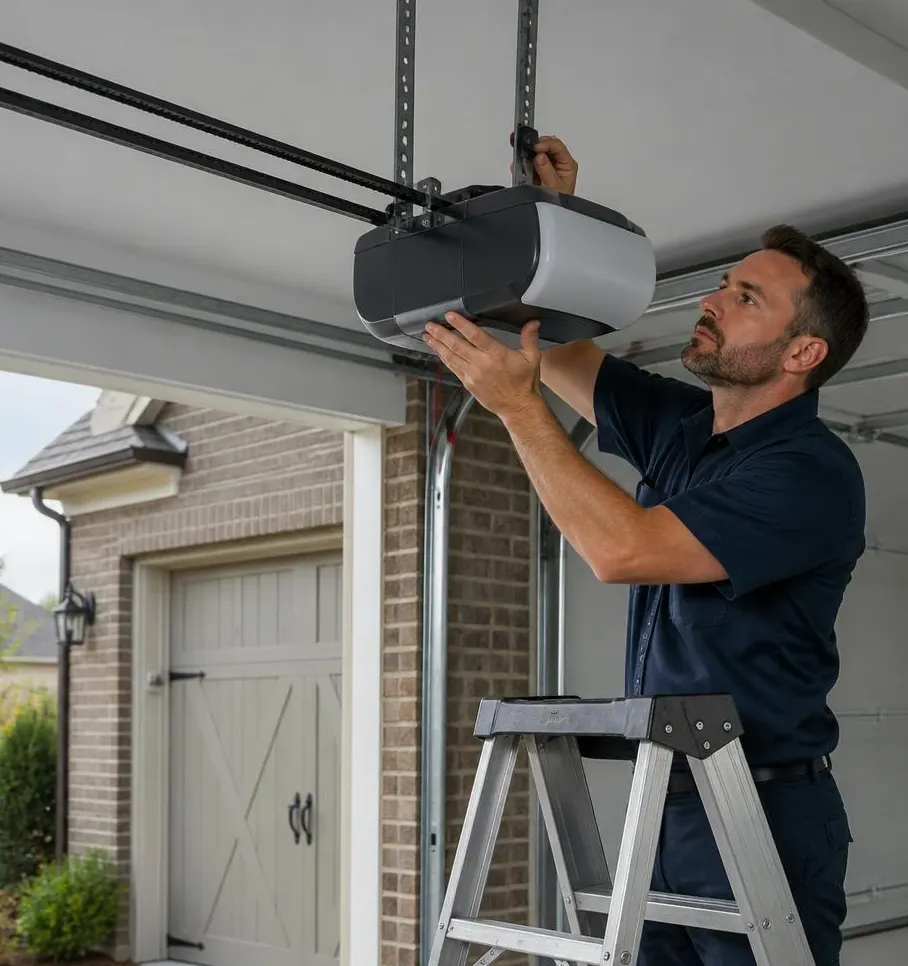
The Moment You Notice It
You hit the opener button on your way out the door, and instead of the usual smooth rise, you get a groan. The door shudders, lifts an inch, and stops. Or it moves at half speed, like something's holding it back. Maybe you walk over and see a thin rim of ice where the bottom seal meets the concrete, and when you give the door a tug, it doesn't let go. Your car is stuck inside, you're already running late, and the opener is making a sound you don't like.
This is one of the most common cold-weather calls technicians get once overnight temperatures drop and stay there. The good news: it's almost always one of a handful of causes, and most of them are fixable without replacing anything.
What the Symptoms Usually Look Like
- Visible frost or ice along the bottom weatherstripping, especially after rain followed by a freeze.
- The door moves in slow motion compared to how it normally operates.
- The opener motor sounds strained but the door barely climbs, or it stalls partway up.
- The opener reverses immediately, as if it thinks something is blocking the door.
- The door opens partway, then stops and won't go further without help.
Each of these points to a different stage in the system, and that's exactly how a technician works through it — starting with the simplest, most visible cause and moving toward the mechanical ones.
Cause 1: Ice Bonding the Seal to the Slab
This is the first thing checked, because it's the most common and the easiest to misdiagnose as a bigger problem. After rain or melting snow, water sits along the base of the door. When temperatures drop overnight, it freezes and glues the rubber weatherstripping to the concrete. The opener has no way to know this — it just tries to pull against the ice, which is why the motor strains and the door may barely move.
The fix: Never force it with the opener repeatedly; that's how gears and belts get damaged. Instead, break the ice bond gently with a flat tool or pour warm (not boiling) water along the seam, then try the door manually. If this happens often, it's worth checking whether the weatherstripping itself is cracked or has lost its shape — a sign it needs replacing before it causes bigger headaches.
Cause 2: Cold-Thickened Lubricant on Tracks and Rollers
If there's no ice, the next check is the hardware itself. Standard grease and old lubricants thicken in cold weather, turning into a sticky drag on the rollers and tracks instead of a smooth coating. This shows up as a door that moves, just slower and with more resistance than usual, particularly on older homes where the hardware hasn't been serviced in a while.
The fix: Clean off the old, gummed-up lubricant and reapply a product rated for cold temperatures. This is routine maintenance, but it matters more here than in milder climates because of how often temperatures swing between freezing nights and warmer, humid days.
Cause 3: Metal Contraction in Springs and Tracks
Cold doesn't just affect lubricant — it affects the metal itself. Torsion springs and tracks contract slightly as temperatures drop, which can change spring tension just enough to throw off the door's balance, or cause rollers to bind where they didn't before. This is more likely in houses with older, original hardware that's already a little worn, since there's less tolerance for the slight dimensional changes cold weather causes.
The fix: A technician checks spring tension and track alignment, adjusting or realigning as needed. This isn't a DIY step — torsion springs are under heavy tension and adjusting them requires the right tools and experience.
Cause 4: Opener Force Settings and Gear Wear
If the hardware checks out but the opener is still straining or reversing on its own, the next stop is the opener itself. Cold can affect belt and chain tension, and an opener's force settings that were fine in October may now trigger the safety reversal too easily — or not easily enough, which is worse. Worn gears, common in older openers, also tend to show their age first in cold weather.
The fix: Adjusting the force and limit settings is sometimes enough. If the drive gear is stripped or the opener is simply old, it may be time for a repair or an upgrade.
Cause 5: A Spring on the Verge of Failing
Last on the checklist, but not least important: cold makes metal more brittle, and a spring that was already fatigued is more likely to snap in freezing weather than in summer. If the door suddenly feels unusually heavy, uneven, or won't stay in place at all, this is worth checking before it fails completely — often during the worst possible moment.
When to Call Potomac Garage Door
If your door is frozen solid, the opener keeps reversing, or you suspect a spring issue, stop trying to force it. Potomac Garage Door handles exactly this kind of call with Emergency Garage Door Service for doors that won't budge safely, and Spring Replacement when tension and age are the real culprits. We also offer seasonal Garage Door Maintenance to catch sticky rollers and worn weatherstripping before the next freeze does it for you.
If your garage door is fighting you this winter, call Potomac Garage Door — serving Potomac, MD and nearby communities with same-day help when the cold won't cooperate.